
There are certain midlife moments nobody really prepares you for. Reading glasses appearing in every room. Random chin hairs with the determination of steel cable. And then there is the day you pull your hair into your usual ponytail and think:
Wait. Why can I see so much scalp on the sides?
For many women, changing hair density becomes much more noticeable in their 40s, 50s and 60s. The American Academy of Dermatology says female-pattern hair loss is the most common cause of hair loss in women and often begins during midlife. A widening part or a ponytail that suddenly seems thinner can be early clues.
I have read that by the time you really notice the hair loss, you have already lost 50 to 70 percent of your previous hair density. Now I don’t know if that is exactly true but it feels very true.
Anyway, we are definitely not talking about a tiny group of women. The AAD estimates hereditary hair loss affects approximately 80 million Americans, including 30 million women. So if you’ve found yourself strategically moving your part, fluffing your roots or positioning a ponytail to disguise those slightly sparse areas around your temples, welcome to a very large club.
The interesting part is that the solutions aren’t all doing the same job. Some can actually treat certain types of hair loss. Others help reduce breakage. Some make existing hair look fuller. And some, like BOLDIFY Hairline Powder, are basically cosmetic camouflage. And honestly? Sometimes camouflage is exactly what I want.
First, Hair Thinning and Hair Loss Aren’t Always the Same Thing
Before buying everything in the hair-growth aisle, it’s worth remembering that “thinning hair” is a description, not a diagnosis. Hair can look thinner because we’re losing hair from the follicle, because individual strands are finer, because we’re experiencing excessive shedding or because hair is breaking before it reaches its previous length and fullness.
Hereditary female-pattern hair loss is especially relevant for midlife women. The AAD notes that it most commonly begins when women are in their 40s, 50s or 60s, although it can happen earlier. And if your hair loss is new, sudden, patchy, painful or accompanied by scalp changes, I would skip experimenting and make a dermatologist appointment.
Hair loss can have numerous causes, and the AAD specifically recommends seeing a board-certified dermatologist when hair becomes noticeably thinner or begins falling out in large amounts.
I have been to the dermatologist several times. Treatments work for a while. Then they don’t or consistency is a necessity to keep it going and with hormones changes there may need to be more changes to treatments made. My doctor has now put me on oral medication. That was recently so I will post again on those results when it has time to actually work.
So here comes BOLDIFY, Which Isn’t Trying to Grow Hair at All
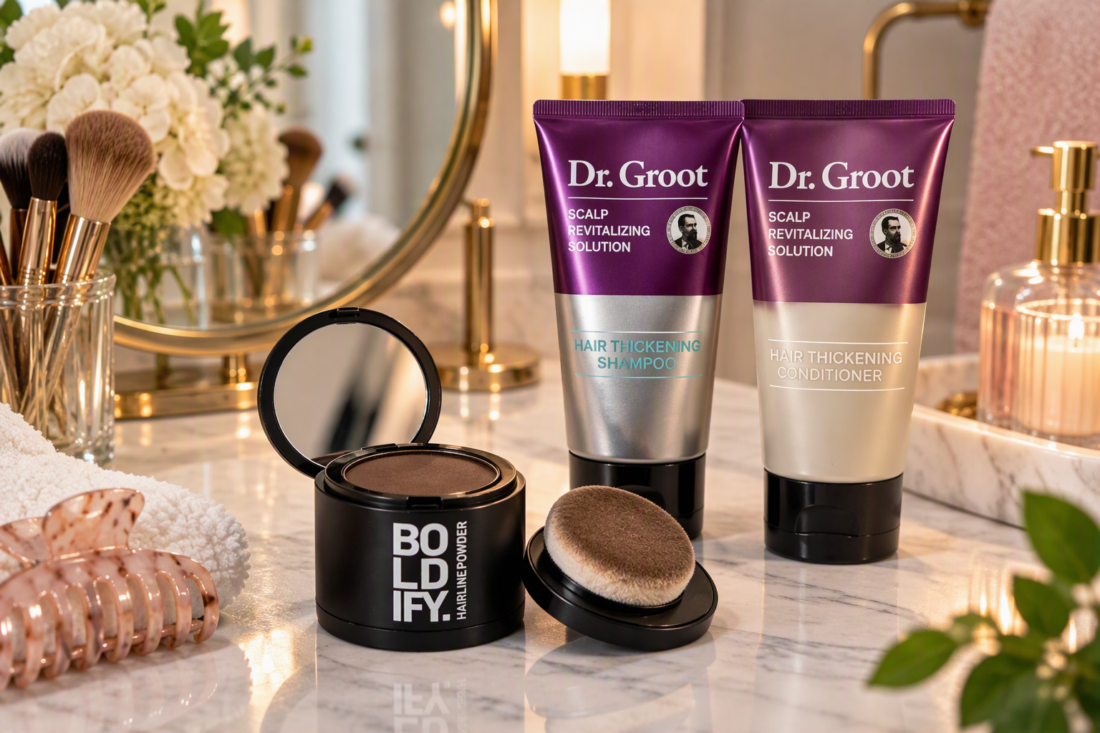
This is where I think expectations matter. BOLDIFY Hairline Powder is not a hair-loss treatment. It isn’t supposed to reactivate follicles or make new hair grow. Instead, it’s one of those wonderfully simple beauty products designed to solve the visual problem right now.
BOLDIFY describes its Hairline Powder as a pigmented powder that adheres to the hair and scalp, allowing you to camouflage sparse areas, thinning spots, grays and root regrowth. The brand currently offers 14 shades. The 4-gram size was listed by BOLDIFY at $21.60 regular price and $17.95 on Amazon when I checked, although prices and promotions can obviously change.


As you can see it isn’t that big, you can travel with this little cutie. The lid stays tight and use the ribbon to pull the lid up. A convenient mirror in the opt. The puff or applicator is on the bottom. It applies well. It doesn’t look odd if you don’t over do it on application.

The Ponytail Trick I Think More Women Should Know About
Imagine pulling your hair back.
Your ponytail itself might look perfectly respectable from behind, but around your temples and immediately above your ears there are those little triangular areas where more scalp shows through than you’d like.
Instead of piling on another volumizer, you can place a small amount of hairline powder directly into those sparse areas and blend it toward your hair. The goal isn’t to paint yourself a completely new hairline. You’re essentially reducing the contrast between hair and scalp.
That small change can make a surprisingly noticeable difference in how dense the area appears. BOLDIFY specifically recommends applying the powder to sparse or thinning areas and blending it in the direction of hair growth. The powder washes out with shampoo. It isn’t sticky or unnatural feeling at all.
This can also be handy along a widening part, around a slightly sparse hairline or in little gaps that become much more visible when your hair is pulled back. That’s what I particularly like about this category: instant gratification. Minoxidil requires patience. Hair-care routines require consistency. A hair powder requires approximately the length of one commercial break.


Just me sitting on my couch, showing off my thinning hair line. The Left is of course, just my thinning hair line, in the middle is a small about of Boldify. See the difference in makes in a short amount of time. Confidence. That is what you gain. Last on the right, is more of a side part and my hair brush out. (Yes, my hair is colored to hide the grays, I don’t like those too much either).
Does BOLDIFY Actually Stay Put?
BOLDIFY describes the formula as water resistant and says its larger Hairline Powder provides natural-looking coverage for up to 48 hours and until shampooing. The formula contains ingredients including mica, talc, silica, dimethicone, kaolin and squalane along with pigments that provide the color.
For everyday use, I’d still treat it like makeup for your scalp rather than expect superhuman behavior from it. BOLDIFY itself recommends dabbing rather than rubbing the hair. It certainly doesn’t last 48 hours for me. Then again, I don’t load it on either. It makes it throw a work day without reapplication.
If you’re using it around a ponytail, start lightly. You can always add more. Too much pigment is when the illusion starts looking less like “naturally thicker hair” and more like “I have definitely put something on my scalp.”
Treatment Versus Cosmetics: This Is an Important Distinction
This may be the most useful way to think about your thinning-hair routine: Minoxidil = treatment for appropriate types of hair loss. (This is the oral medication I have now been prescribed). Thickening shampoo and conditioner = improve hair/scalp condition, volume and/or reduce breakage depending upon the formula. Hairline powder and fibers = camouflage. They’re doing completely different jobs, which means using a cosmetic concealer doesn’t somehow mean you’ve “given up” on treating thinning hair.
You can treat the underlying problem and still want your ponytail to look better this afternoon.
What Are the Most Popular Over-the-Counter Hair-Loss Options?
The one ingredient I would put in a distinctly different category from cosmetic products is topical minoxidil. The AAD notes that topical minoxidil is FDA approved for hair loss in every adult and says it has been shown to reduce hair loss, stimulate hair growth and strengthen existing strands.
That does not mean every woman with thinning hair automatically needs minoxidil because the cause of the thinning still matters. But when we’re talking about evidence-based OTC treatment, minoxidil deserves to be separated from cosmetic serums, supplements, shampoos and scalp treatments that sometimes get marketed in very similar language.
Beyond minoxidil, you’ll see a huge assortment of products targeted toward thinning hair, including volumizing and thickening shampoos, conditioners, scalp serums, hair fibers, powders and nutritional supplements.This is where I would become a slightly skeptical shopper.
“Supports healthy-looking hair” and “makes hair look thicker” are not the same claim as regrows hair.
So Where Does Dr. Groot Hair Thickening Shampoo Fit In?
I actually think thickening shampoos make much more sense once we stop expecting shampoo to behave like a medication.
Dr. Groot Hair Thickening Shampoo (I wrote a blog on this brand) is positioned as a scalp-focused shampoo for thinning and fine hair. The company’s current formula highlights ingredients including biotin, rosemary oil, caffeine and prebiotics. According to Dr. Groot, clinical testing showed a 169% improvement in scalp moisture and 76% reduction in buildup.
This is a different strategy from minoxidil. Think of shampoo as working on the environment and the hair you currently have. A well-formulated thickening shampoo can remove oils and styling-product buildup that weigh fine hair down. That alone can allow hair to lift away from the scalp and appear fuller. Then there is breakage.
If you’re losing length and density because fragile strands continually snap, keeping those existing strands in better condition can make your overall head of hair appear fuller over time. What I would not do is confuse prettier, fuller-looking existing hair with creating entirely new follicles.
That distinction is particularly important when shopping for “hair-loss” shampoo.
And Thickening Conditioner Isn’t an Oxymoron
If you have fine hair, you’ve probably experienced the conditioner dilemma. You need conditioner because dry, fragile hair breaks. But use something too heavy and suddenly the three hairs you were trying to volumize are lying perfectly flat against your scalp.
That’s why lightweight thickening conditioners are interesting.
Dr. Groot Hair Thickening Conditioner is formulated with ingredients including rosemary, biotin and niacinamide. Dr. Groot says its testing showed an 82.2% reduction in hair loss due to breakage. Notice those last three words: due to breakage. That’s an important distinction from claiming that the conditioner treats female-pattern hair loss. [mydrgroot.com]
The conditioner is essentially trying to help maintain and strengthen the hair that’s already on your head without sacrificing all the volume you were trying to create with your shampoo. For mature hair that may be drier, more fragile and simultaneously getting finer, that can be a really useful balance.
Women Are Spending Serious Money on Thinning Hair
It is difficult to put a single defensible number on exactly how much Americans spend each year because market reports define the hair-loss category differently. Some include pharmaceuticals, procedures and devices, while others include cosmetic shampoos, serums and supplements.
One 2026 market analysis estimates the U.S. hair-thinning market was approximately $1.5 billion in 2025, with products and services encompassing shampoos, serums, supplements and medical procedures according to statifacts.com.
That’s an enormous market built around a concern that can feel incredibly personal. And it helps explain why we’re surrounded by products promising thicker, denser, stronger, fuller and healthier-looking hair. Those words sound similar. They don’t necessarily mean the same thing.
Because sometimes we need science.
Sometimes we need patience.And sometimes we just need a tiny compact of brown powder before we walk out the door.
Thinning Hair After 45
Approximately 30 million American women are affected by hereditary hair loss, and female-pattern hair loss often becomes apparent in the same decades when we’re dealing with countless other changes in our skin, hormones and bodies.
If treating it makes you feel better, treat it. Or if putting BOLDIFY along your temples makes your ponytail look twice as good, use the powder. If improving your shampoo and conditioning routine makes fine hair behave better, wonderful.
And if you want to do all three? That’s probably the most realistic midlife answer of all. Because at Twilight Kaleidoscope, we’re not interested in pretending we’re 25.
We are interested in finding the things that actually work for the women we are now.
This article is for informational purposes and is not medical advice. New, sudden, patchy or significant hair loss is worth discussing with a board-certified dermatologist or medical professional.

Leave a Reply