
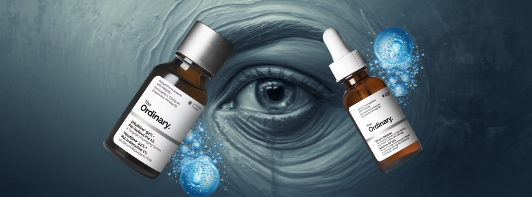
AI generated picture with Volufiline 92% and Growth Factors from The Ordinary
The Ordinary’s Line of products
I have loved the Ordinary for years. The vintage line was centered around one or perhaps two hero ingredients. They were revolutionary when they started.
The new ordinary launch have more ingredients. They target many different concerns.
Do Growth Factors and Volufiline target the same thing?
Two of them seems to be targeting the same thing. Volume. But do they both work the same way or work equally as well on aging skin? Let’s do a deep dive in on two products in their line.

Growth Factors 15%
What are growth factor?

Growth factors bind to receptors on skin cells and trigger a cascade of repair signals. In skincare, they’re mainly used to support collagen and elastin (firmer skin), cell renewal and regeneration (Smoother texture). As well as the skin barrier repair.
They don’t “add” anything artificial to your face. They have a “chat” with your skin to have it behave as it did when it was younger. At least that this the premise behind growth factors.
Volufiline
What is Volufiline ?
Volufiline is a patented cosmetic ingredient designed to make skin look fuller and more plump by targeting volume loss. It was originally developed by the French ingredient company Sederma (now part of Croda). It’s a blend of Anemarrhena asphodeloides root extract. As well as an oil‑based carrier (usually hydrogenated polyisobutene) and finally, the plant extract is sarsasapogenin, a plant‑derived compound.
That is a lot that may not make any sense. We can do a deep dive into those ingredients later. Let’s look at which each of these products address in the way of skin care.
What skin concern each one is actually targeting
| Concern | Volufiline 92% | Growth Factors 15% |
|---|---|---|
| Facial hollowness | ✅ Primary target | ❌ Indirect only |
| Loss of fat pads (cheeks, under‑eyes, temples) | ✅ | ❌ |
| Fine lines from volume loss | ✅ | ✅ (secondary) |
| Wrinkles from collagen breakdown | ❌ | ✅ Primary target |
| Skin thinning / fragility | Minimal | ✅ |
| Barrier resilience | Mild | ✅ |
This is the biggest difference
Volufiline 92% – Acts on the hypodermic (relating to the region immediately beneath the skin). Growth Factors 15% – acts on the Dermis (the thick layer of living tissue below the epidermis).
Say what? Okay. hypodermic is the fat layer and Dermis is the structural layer.
What did the studies say:
Evidence quality (important for expectations)
| Category | Volufiline | Growth Factors |
|---|---|---|
| In‑vitro data | Strong data | Strong data |
| Human trials | Small, manufacturer‑run | Limited cosmetic‑grade |
| Independent replication | Minimal | Minimal |
Which means we don’t have much reassurance with the trials or studies. I don’t know if we have any independent studies. I couldn’t find them. If you can find them let me know.
What results people actually see
Volufiline real life results
Volufiline (3–6 weeks): subtle plumping in under-eyes, cheeks and small lines. Some say a rested appearance. Needs consistent use.
Growth Factors real life results
Growth Factors (8–12+ weeks): Smoother texture, less crepey skin, skin look “healthier”. Again, needs consistent use.
Who does it work for best
Choose Volufiline if:
- You’re 35–55
- Your main issue is hollowing, not wrinkles
- You notice: Sunken under‑eyes, Flattened cheeks, early facial deflation
- You want targeted correction
Choose Growth Factors if:
- You’re 30+ (especially post‑retinoid use)
- Your main issue is skin thinning or fragility
- You want: Long‑term skin resilience,
- Better barrier repair, alongside retinoids or acids (Although their “sister” NIOD makes a better product for this purpose- skin barrier repair
Can they be used together?
Yes — and this is actually the smartest use case
How they complement each other:
- Growth Factors improve skin quality
- Volufiline improves facial contour appearance
They do different jobs, at different depths, with no ingredient conflict.
Which one should YOU prioritize?
If you must choose only one:
Pick Volufiline if your main complaint is:
“My face looks tired, hollow, or deflated.”
Pick Growth Factors if your main complaint is:
“My skin feels thinner, weaker, or more wrinkled.”
Bottom‑line verdict (no hype)
- Volufiline = cosmetic volume support
- Growth Factors = structural skin support
- Neither replaces fillers, lasers, or retinoids
- Together, they address two different pillars of facial aging
In the future, we can deep dive into each product from The Ordinary and from their other company, NIOD.
Join us as we discovery skin care for everyone. Hopefully, it will help you decide on what you need in your routine.

Leave a Reply